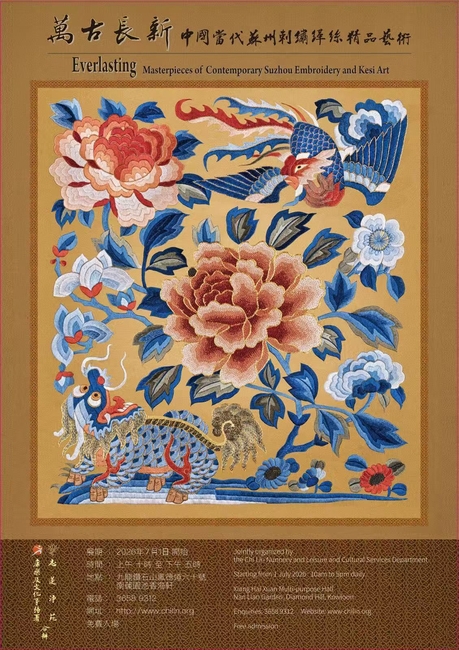
As a traditional Chinese folk craft, embroidery is renowned worldwide for its magnificent patterns and masterful craftsmanship. As early as the Shang and Zhou dynasties, China’s embroidery sector had already reached a certain scale, primarily used for clothing. During the Qin and Han dynasties, embroidery became an important commodity, exported via the Silk Road to Central Asia, Europe, and other regions, where it was widely popular. The Tang and Song dynasties marked the golden age of embroidery art. The imperial court gathered a large number of skilled embroiderers and established embroidery academies, which promoted the advancement and innovation of embroidery techniques. Works based on paintings emerged, featuring richer colors and a pursuit of delicate, lifelike artistic effects. By the Ming and Qing dynasties, embroidery had become widely popular among the common people, giving rise to regional schools with distinct characteristics. The most renowned are the "Four Great Styles of Embroideries": Su embroidery, Xiang embroidery, Yue embroidery, and Shu embroidery. Each of these schools possesses unique features, elevating the art of Chinese embroidery to new heights.
Kesi originating in the Sui and Tang dynasties and reaching its peak during the Song dynasty, is a unique silk textile with a long history and exquisite craftsmanship. It uses single-colored raw silk for the warp and richly colored processed silk threads for the weft, employing the ‘continuous warp, interrupted weft’ technique to weave soft yet resilient plain weave fabric. On the finished product, the areas between colors exhibit marks resembling knife-carvings, which is why kesi is also known as 'Engraved Silk' or 'Carved Silk.' The weaving process of Kesi is extremely complex, requiring extraordinary skill and immense patience. Every step must be meticulously control, and each piece of Kesi is imbued with the artisan’s dedication and wisdom. It is precisely this pursuit of perfection in craftsmanship that makes Kesi textiles exceptionally exquisite, earning them the reputations of 'an inch of Kesi is worth an inch of gold' and 'the supreme fabric in weaving.' Kesi was deeply cherished by the imperial court and nobility in ancient times, often used to weave garments for emperors and empresses, imperial portraits, or to reproduce celebrated calligraphy and paintings. Its exquisite craftsmanship, subtle details, and exceptional artistic taste are truly remarkable, making it the quintessence of Chinese silk art. However, after the Qing dynasty, the Kesi industry gradually declined, with only Suzhou preserving and passing down this craft.
In modern society, Embroidery and Kesi continue to hold broad practical value, being used to create high-end apparel, home furnishings, and decorative art pieces. They serves as important vehicles for showcasing traditional Chinese culture. Outstanding works in this field have attained the cultural, historical, artistic, and collectible value, thereby entering the realm of fine art.
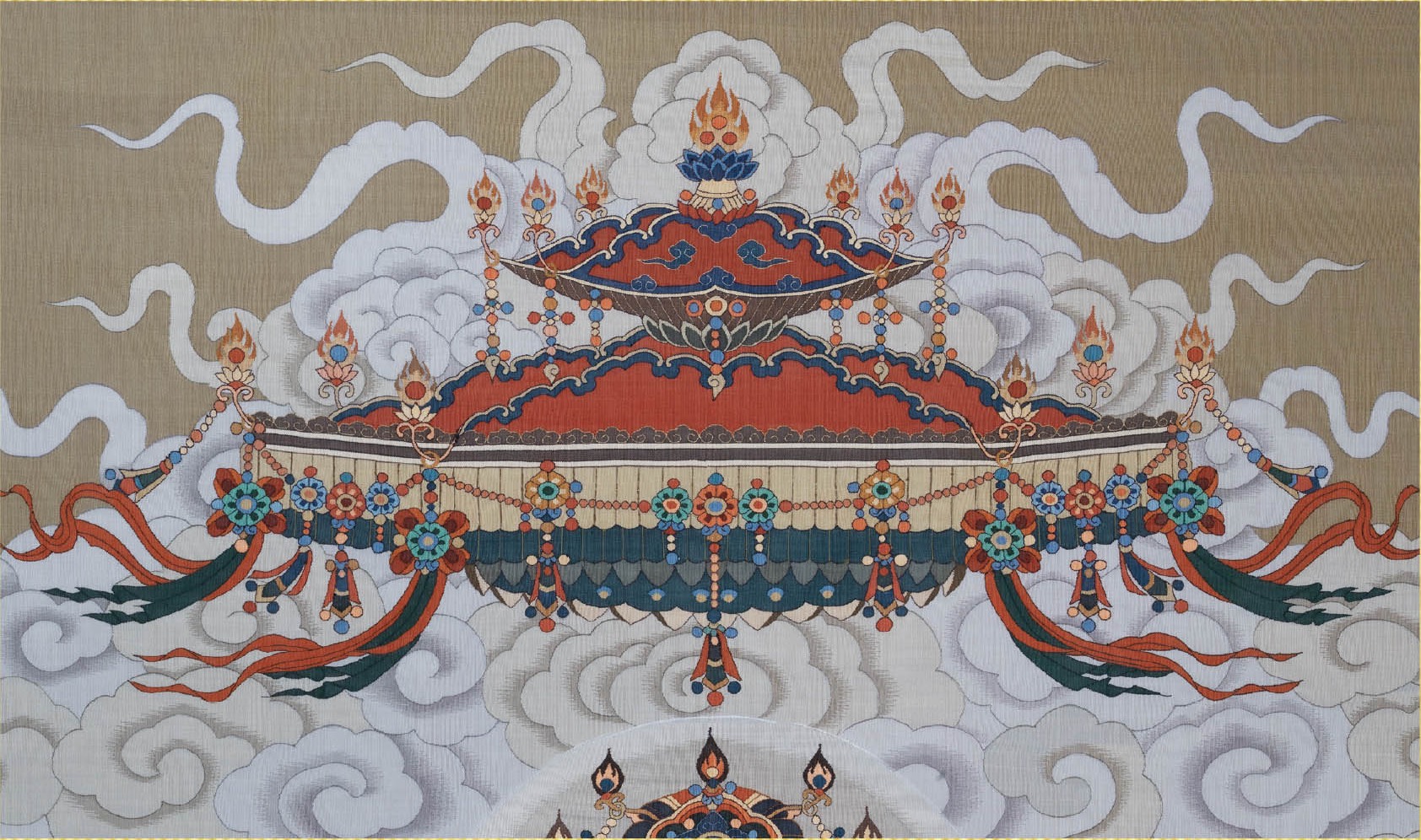
Dimensions: Width 745 mm, Height 1345 mm
Mahasthamaprapta Bodhisattva is one of the Three Holy Ones of the West, attending Amita Buddha alongside Avalokiteshvara Bodhisattva in receiving sentient beings. The main statue of the Buddha sits cross-legged on a lotus throne, with an elaborately decorated canopy above the head, surrounded by layers of cloud patterns that highlight the theme. This kesi piece skillfully combines long and short wefts, flat wefts, cross wefts, knit wefts, and blending techniques to create an elegant and lively effect.
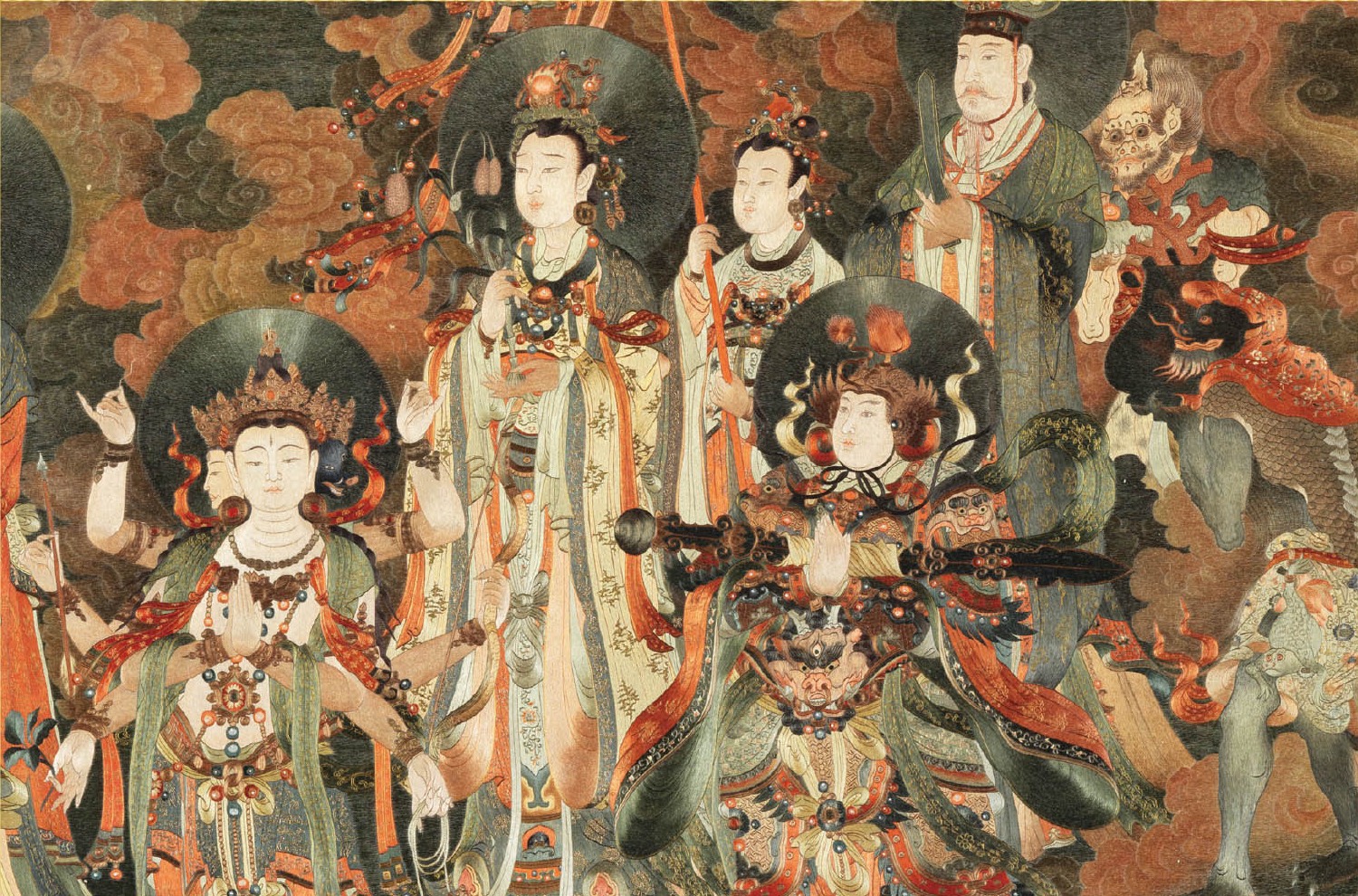
Protecting the Dharma (partial section)
Dimensions: Width 2320 mm, Height 1130 mm
This scene is from the main mural at Fahai Monastery. It shows Brahma leading nineteen celestial guardians to pay their respects to Buddha. The embroidered piece uses over ten techniques, including loose punch needlework, tack needlework, grain stitch, and thick stitch. Some techniques revive long-lost skills and were used to creatively craft this artistic masterpiece.
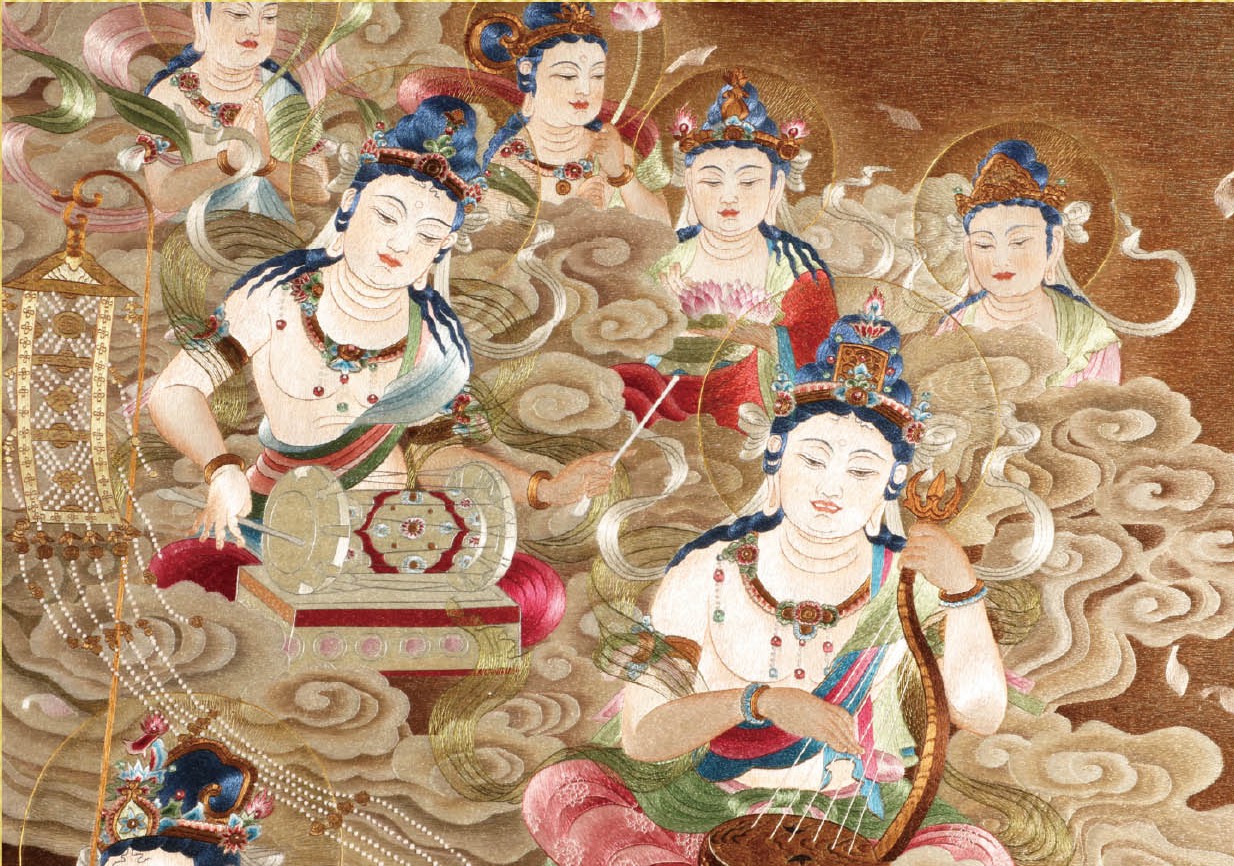
Dimensions: 1620 mm wide, 990 mm high
Bodhisattvas arrive on clouds, playing music and welcoming practitioners to the Pure Land of Amita Buddha. This embroidered piece uses over 300 different colored threads and more than ten stitching techniques, including plain punch, loose punch needlework, backstitch, and grain stitch. The figures' postures, expressions, and clothing, as well as the surrounding seawater, are depicted with innovative methods, making it a masterpiece.
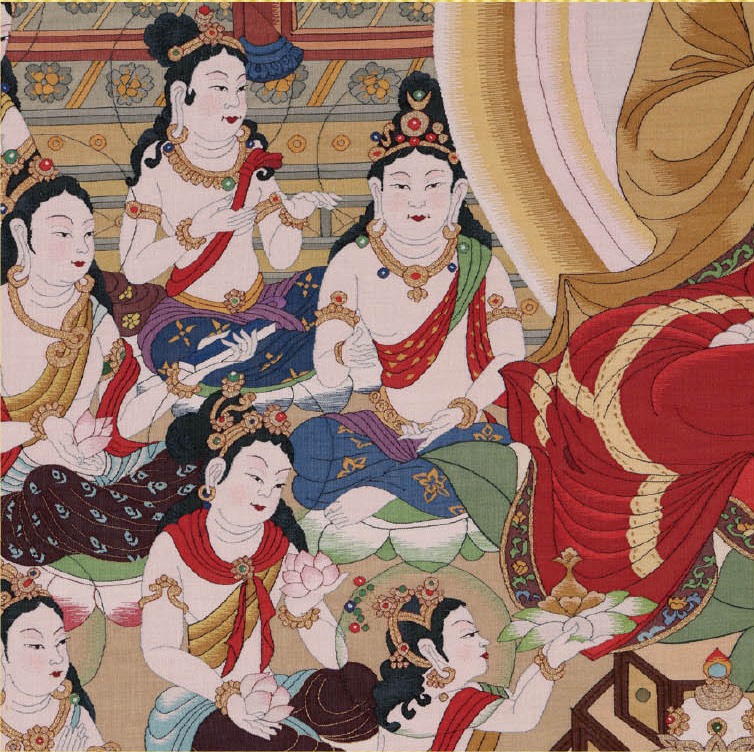
Dimensions: Width 785mm, Height 940mm
This is a partial section of ‘Illustrations of the Pure Land Sutra,’ depicting Bodhisattvas paying homage to Amita Buddha and assisting him in spreading the Dharma. The piece perfectly captures the solemn beauty of the Western Pure Land. This kesi piece uses a segmented carving and weaving technique with patterns that resemble knife engravings. The colors are naturally blended using the long-and-short weft technique, creating a complex composition that is both gorgeous and elegant.
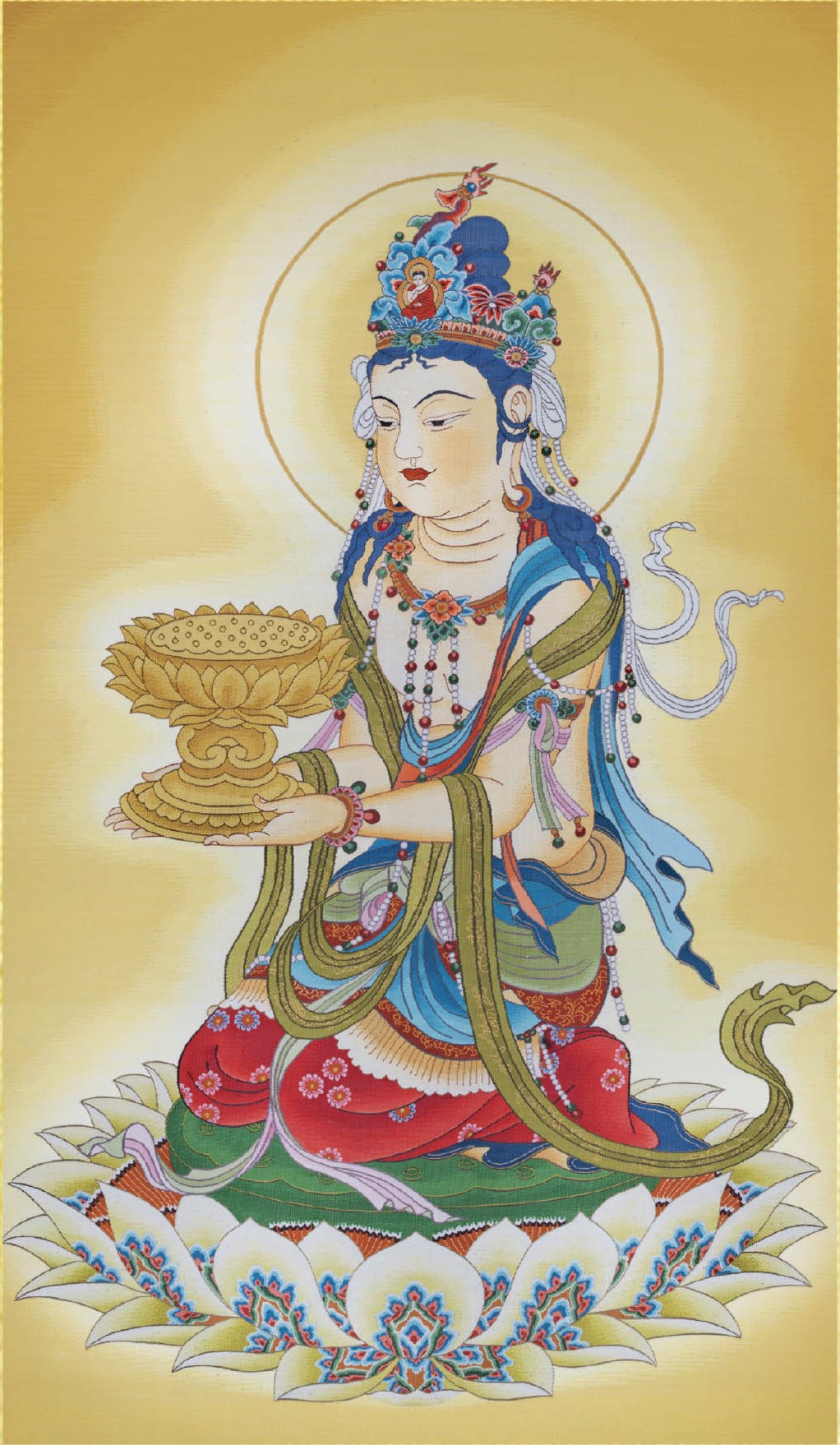
Dimensions: Width 495mm, Height 810mm
This kesi work is a partial section of Amita Buddha and the Twenty-Five Bodhisattvas Greeting. It depicts practitioners reciting the Buddha's name in prayer. Avalokiteśvara Bodhisattva, Amita Buddha’s attendant, holds a golden platform and leads a group of Bodhisattvas in welcoming practitioners to the Western Pure Land. The nine levels of lotus rebirth are manifested in an instant.
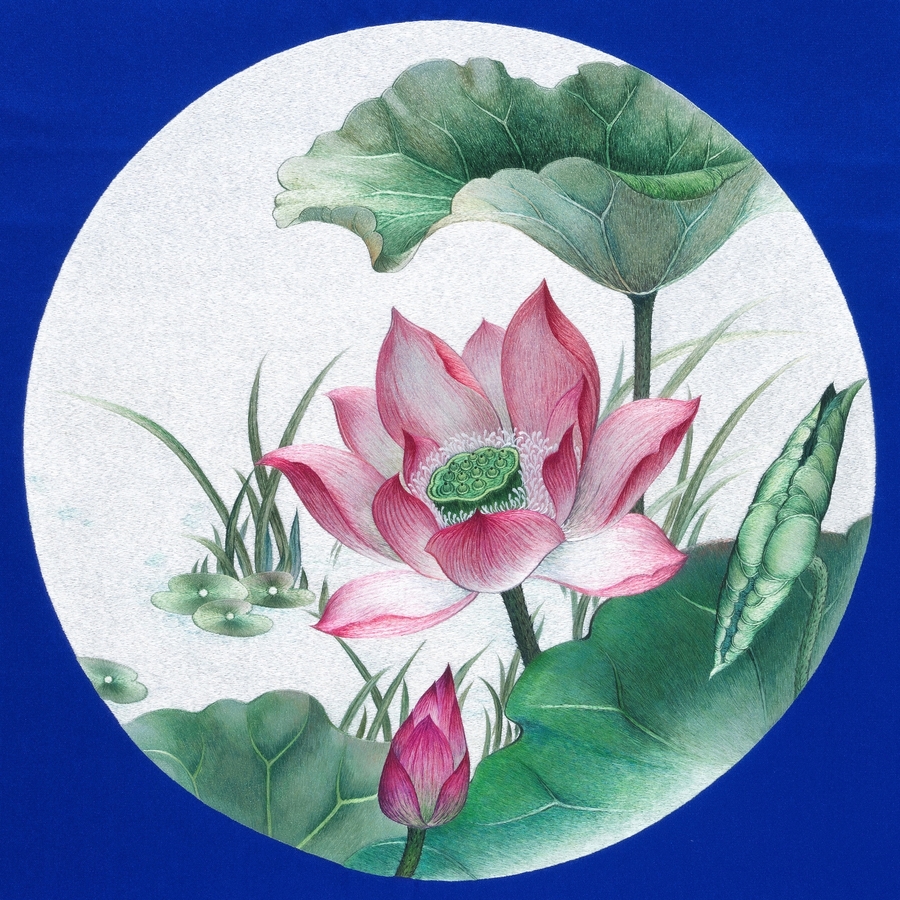
Dimensions: Width 380 mm, Height 660 mm
In Buddhism, the lotus symbolizes emerging unstained from the mud, representing the Eternal True Mind and aesthetic idea of unobstructed harmony. The flowers and leaves are artistically arranged in the medallion. The petals are shaded with punch needlework, and the leaves are shaded with plain tack needlework and compact and outspread stitches to show depth. The pink lotus and green leaves blend together gently, creating an elegant, harmonious contrast. The embroidery is exquisite.
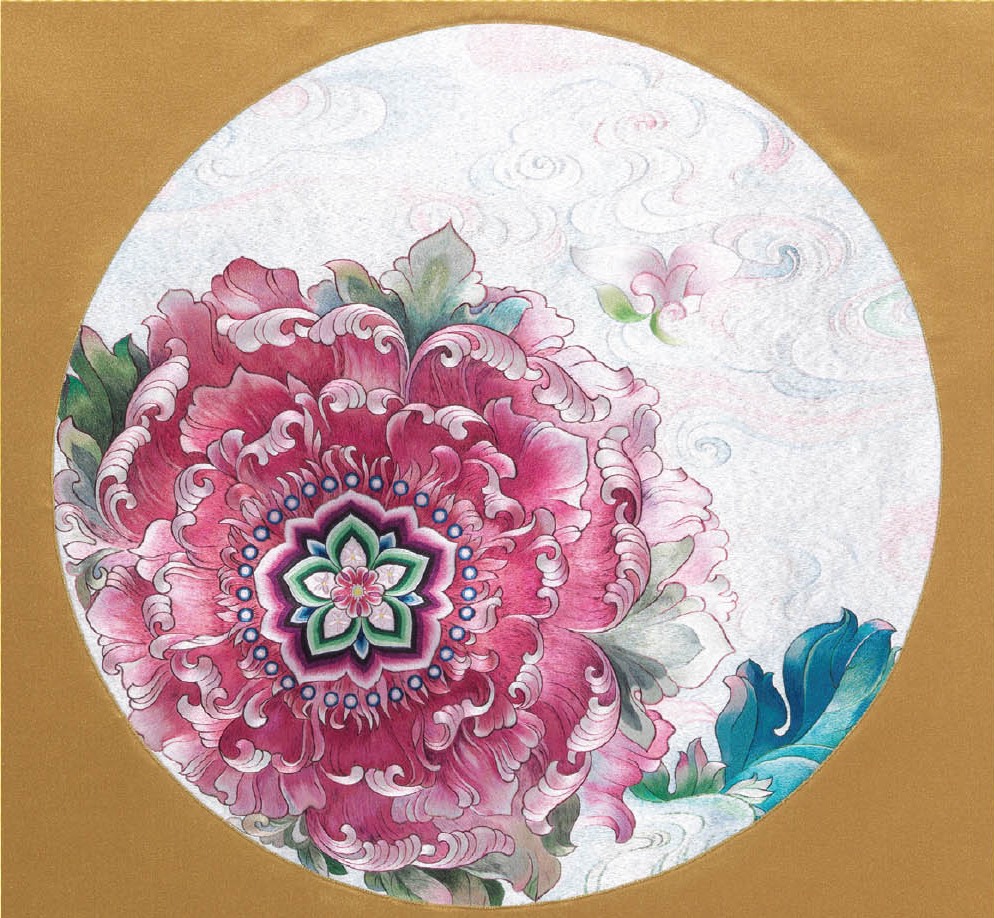
Dimensions: Width 380 mm, Height 660 mm
The medallion resembles a full moon, and faint, auspicious clouds subtly hint at the clear radiance of a half-moon. The moon reflecting in all rivers, the universal illumination of Buddha's teachings, seeing Buddha when flowers bloom, and dispelling ignorance are implied metaphors. This embroidered piece uses punch needlework to shade the peony petals in layers. The central precious flower is done with tack needlework, and the auspicious clouds are rendered with free stitches to create a hazy layering effect.
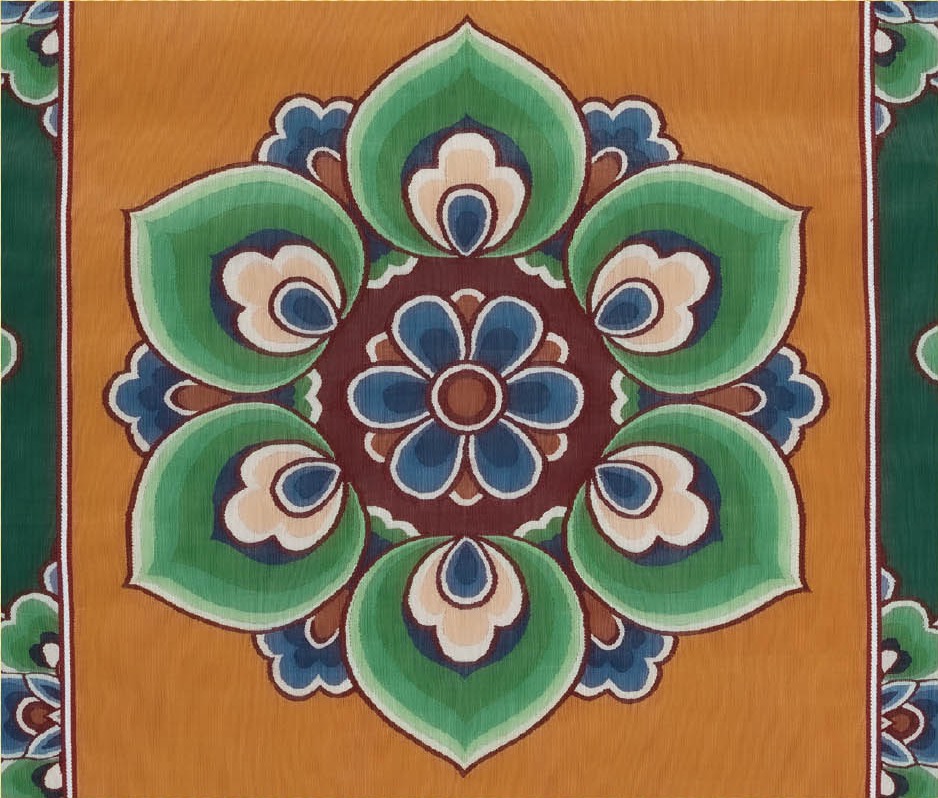
Dimensions: Width 570 mm, Height 880 mm
This is a finely woven kesi piece with a Tang flower pattern, featuring round floral and auspicious flower designs that reflect the symmetrical aesthetics of Buddhist mandalas. The edges of the petals are cut like chisels, and the textures are clear and crisp. The weft technique displays color transitions and inherits the high-saturation color system of Dunhuang murals. Warm and cool contrasts give it a refined and gentle feel.
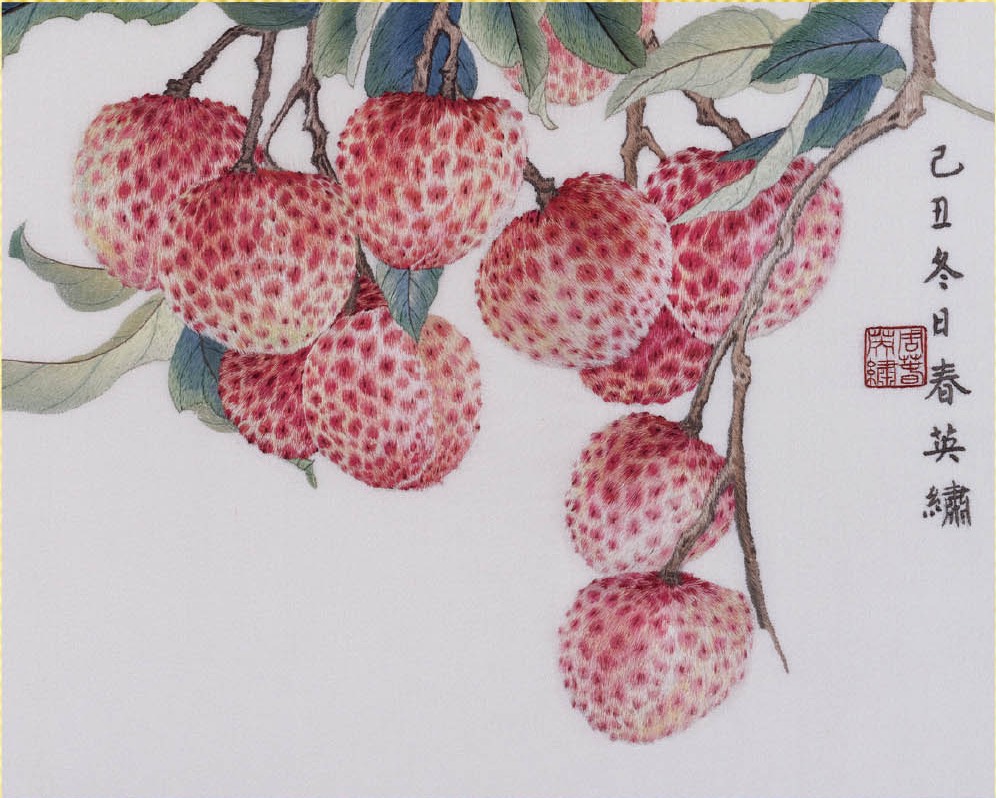
The texture and appearance of the object is restored with fine and dense stitches by splitting the threads to 1/16 using free stitch combined with flat embroidery. The fruit peel is shaded with multiple colors of thread to create transparency and luster. The leaves are given a three-dimensional appearance through variations of dark and light colors. The branches are embroidered with rolling stitches to produce a vigorous texture. The layout is a typical literati painting, showing vitality within its elegant and refined style.
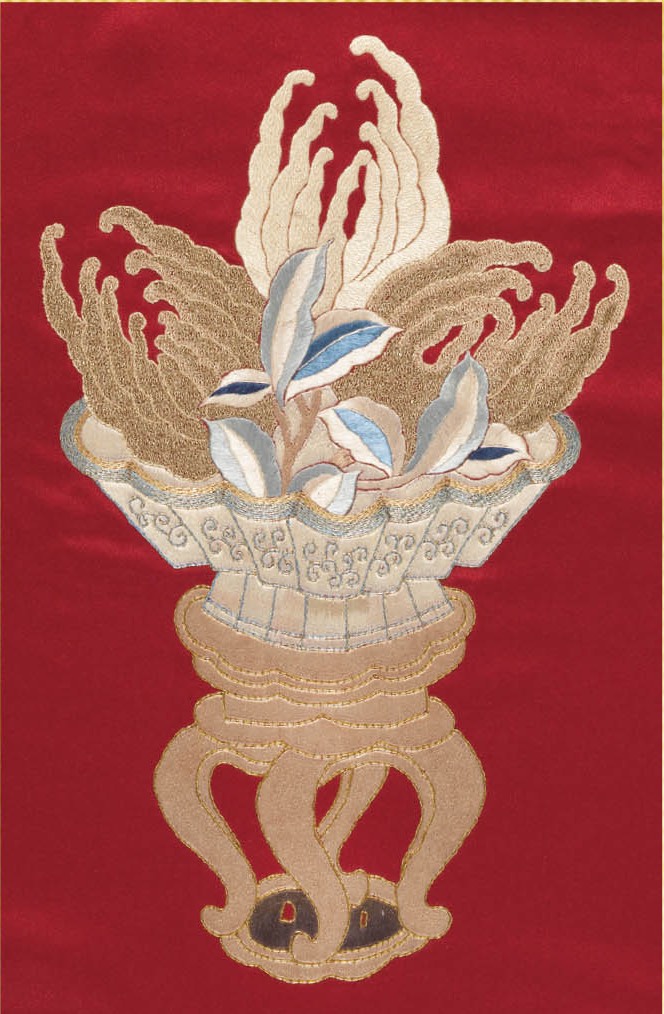
Dimensions: Width 385 mm, Height 620 mm
The pattern symbolizes ‘Buddha's hand offering protection and blessings.’ The plain embroidery accented with gold exudes a solemn Zen vibe. It combines tack needlework, punch needlework, grain stitching, and gold thread embroidery. Buddha's hand is the main motif, and the off-white and light brown tones, along with the blue-to-white leaves, create a soft texture with light and shadow layers. The overall appearance is simple, elegant, and soft.
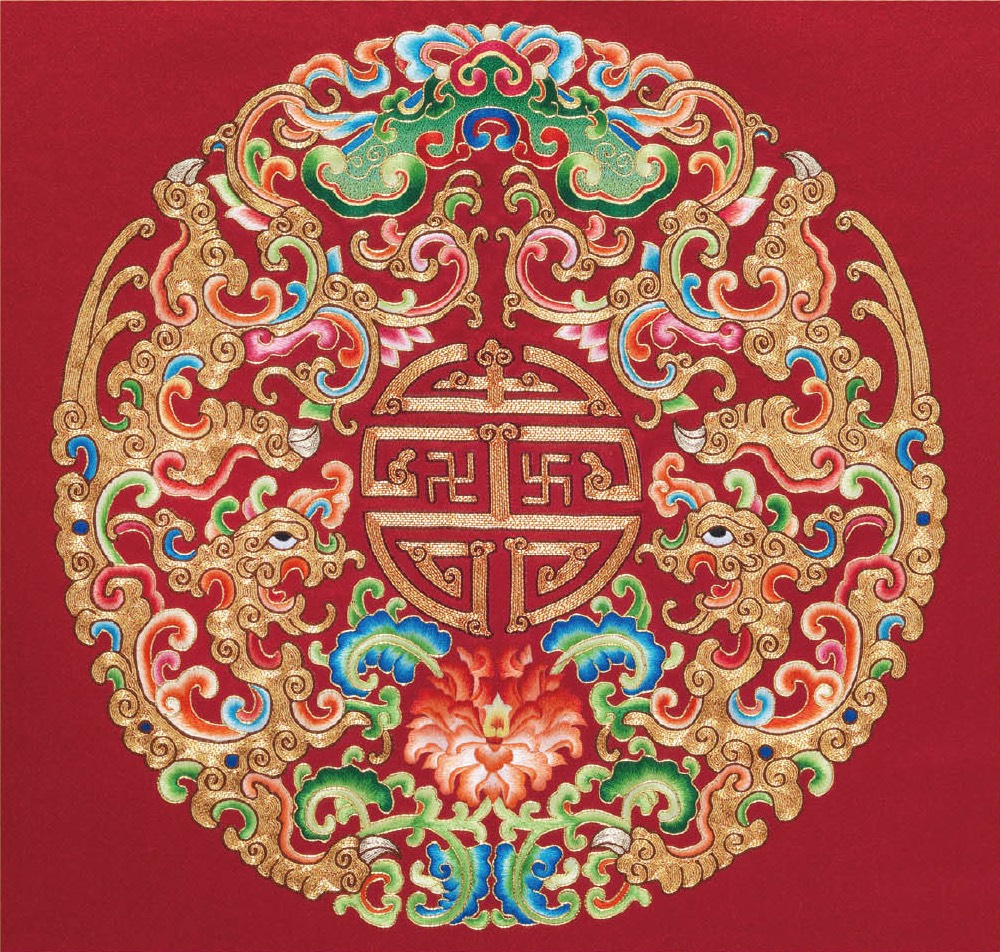
Dimensions: Width 380 mm, Height 650 mm
The double dragon arching over the longevity pattern symbolizes continuous blessings, longevity, and protection through the Buddha's teachings. The composition is tight and full. Gold thread embroidery is the primary technique used in the entire piece, complemented with punch needle work. The red background is accented with gold threads, indigo green, and pastel colors, creating a balance between warm and cool tones with strikingly contrasting yet harmoniously unified auspicious clouds and flowers.
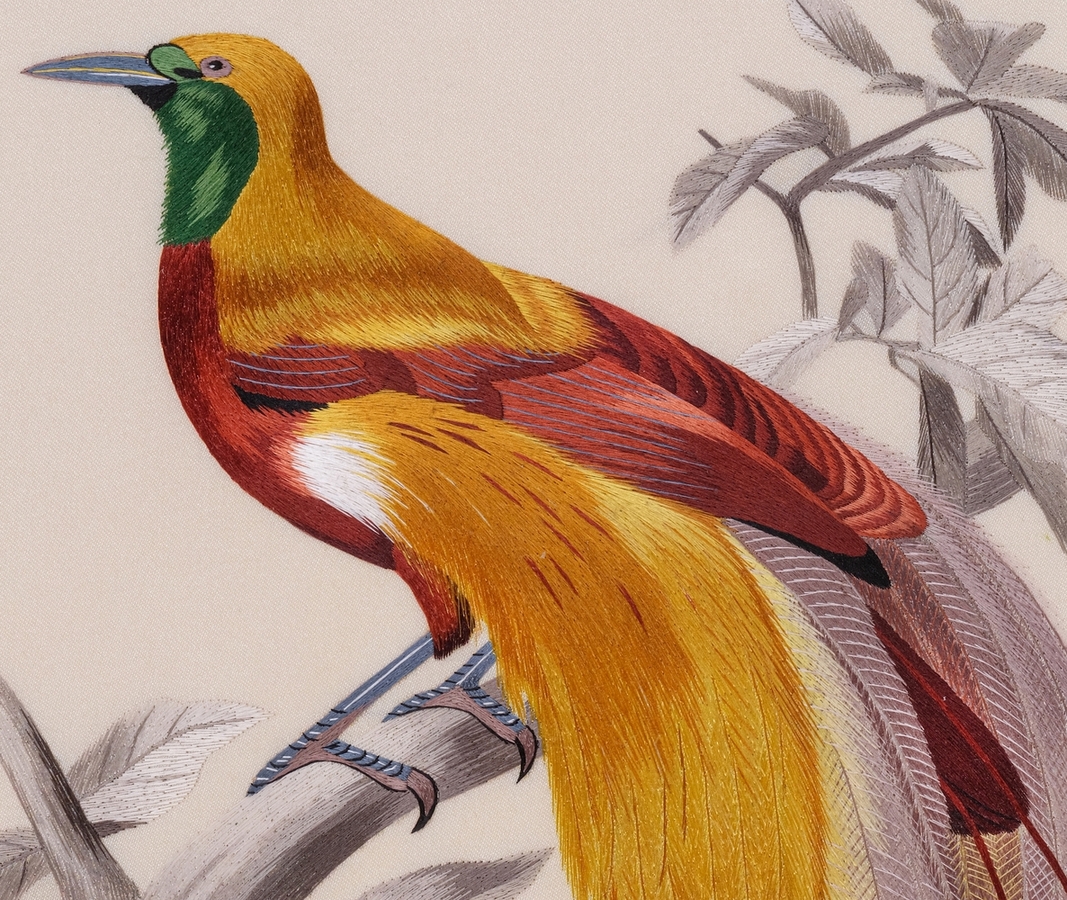
Dimensions: Width 230 mm, Height 325 mm
Males have vibrant plumage and long, ornamental feathers that extend from their tails or heads. Their appearance is magnificent. The embroidery features warm gold and reddish- brown threads interwoven with short, close punch needlework. The tail feathers hang delicately and realistically. The skilful use of shading stitches creates natural colour transitions, capturing the bird's graceful vitality and noble charm.
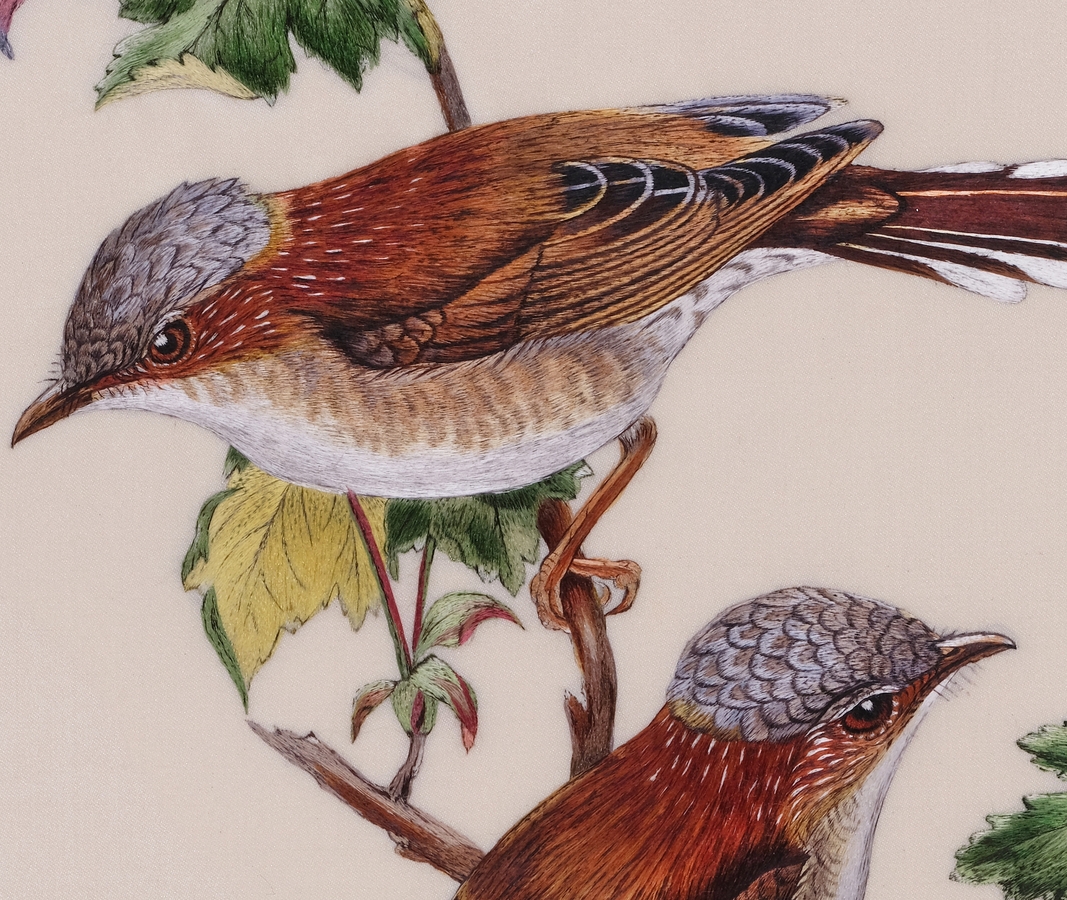
Dimensions: Width 415 mm, Height 570 mm
A small Asian bird with a graceful build and striking contrast between the plumage on its head and back. The embroidered piece uses short, dense stitches to capture the delicate texture and natural feel of the bird’s plumage, featuring an elegant color palette and even, clean stitching. The pair of birds perched on a branch exchange glances with lively charm, set against a backdrop of pale green branches; the interplay between the flowers and birds creates a delightful scene brimming with vitality.
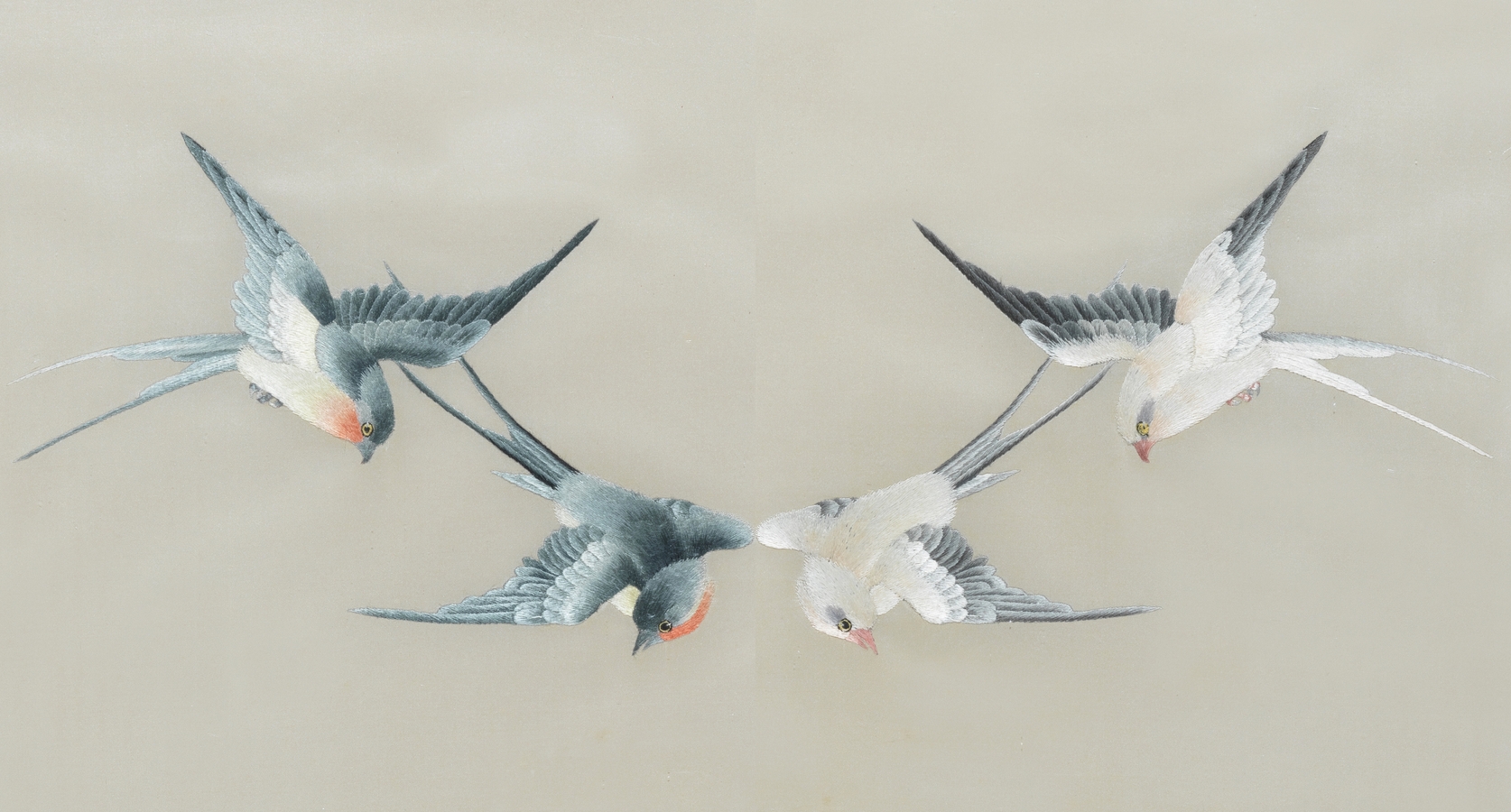
Dimensions: Width 410, Height 715 mm
The double-sided, contrasting-colour embroidery features a blend of cool and warm tones. The swallows on the front are elegant and gentle in a grey-black colour, while the swallows on the back are plain white, creating a lively and bright aesthetic. The work is made with double-sided stitching and plain stitch, using thread colour matching and stitch transitions to achieve colour gradation, conveying wishes for harmony, health and happiness.